The Best Retro Coffee Makers of 2026: Drip & Espresso Machines, Smeg Dupes
This post contains affiliate links. If you buy through them, we may earn a small commission at no cost to you.
Our top pick among the retro appliances in this guide is Smeg 50's Retro Style Drip Coffee Machine (10-Cup, Cream) ($259.95). The original domed silhouette every retro coffee maker imitates — die-cast body, chrome details, auto-start timer, keep-warm plate and two strength settings, in Smeg's unmistakable 1950s cream. Check price →
Shop the Retro Appliances
Tap any piece to shop it.

Smeg 50's Retro Style Drip Coffee Machine (10-Cup, Cream)
The original domed silhouette every retro coffee maker imitates — die-cast body, chrome details, auto-start timer, keep-warm plate and two strength settings, in Smeg's unmistakable 1950s cream.
Check price on Amazon →Retro Appliances compared at a glance
| Retro Appliances | Best for | Price | Shop link | Save |
|---|---|---|---|---|
| Smeg 50's Retro Style Drip Coffee Machine (10-Cup, Cream) | The icon | $259.95 | Shop → | |
 Haden 12-Cup Programmable Retro Drip Coffee Maker Haden 12-Cup Programmable Retro Drip Coffee Maker | Best mid-range | $69.95 | Shop → | |
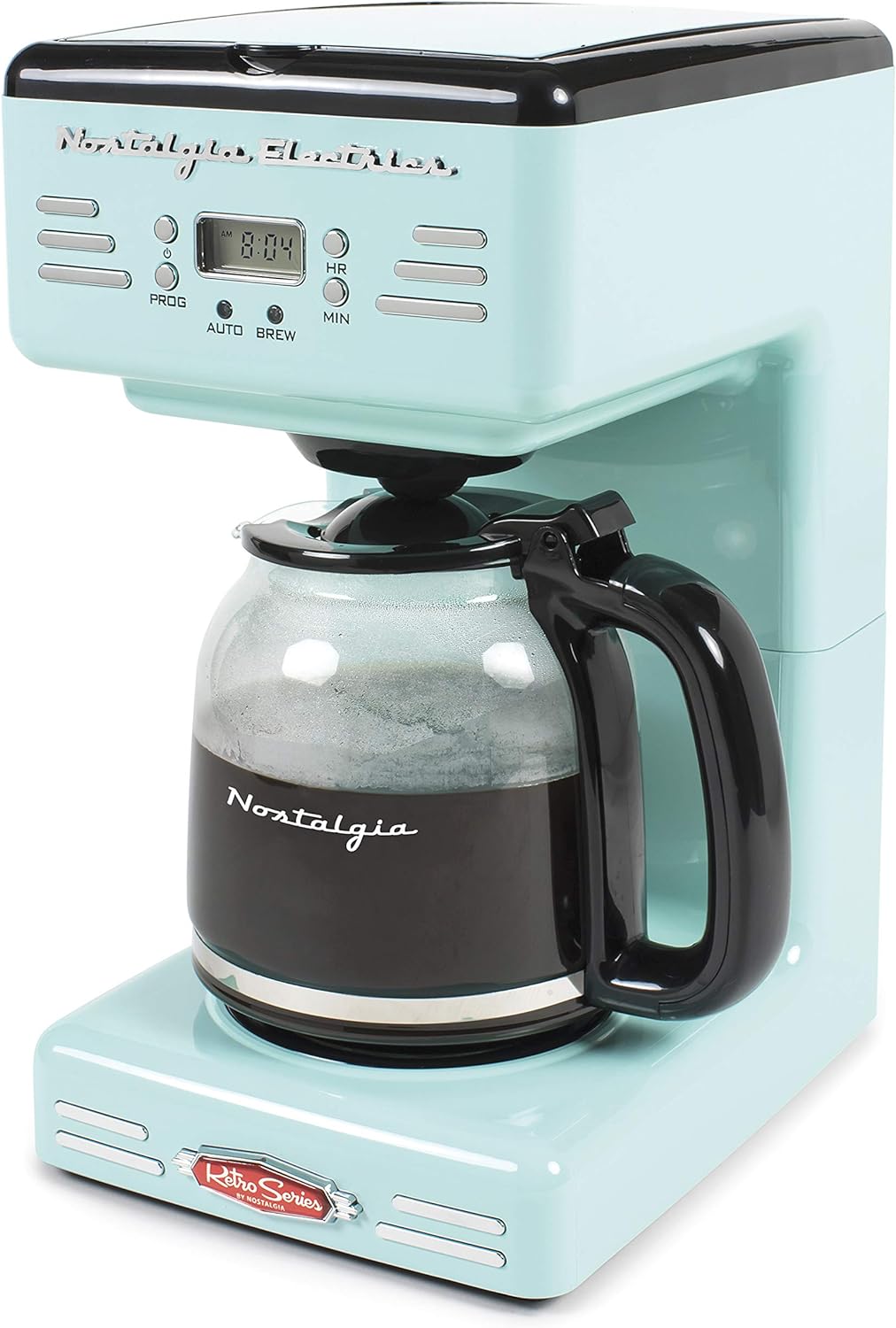 Nostalgia Retro 12-Cup Programmable Coffee Maker Nostalgia Retro 12-Cup Programmable Coffee Maker | Best value | $59.99 | Shop → | |
 Amaste Retro Drip Coffee Maker with 25 oz Glass Pot Amaste Retro Drip Coffee Maker with 25 oz Glass Pot | Cutest small-batch | $69.99 | Shop → | |
 SUMSATY 20-Bar Retro Espresso Machine with Milk Frother SUMSATY 20-Bar Retro Espresso Machine with Milk Frother | Best espresso | $139.99 | Shop → | |
 Presto 12-Cup Stainless Steel Electric Percolator Presto 12-Cup Stainless Steel Electric Percolator | True 1950s method | $76.79 | Shop → | |
 Bodum Chambord 51 oz French Press Coffee Maker, Borosilicate Glass and Polished Stainless Steel Bodum Chambord 51 oz French Press Coffee Maker, Borosilicate Glass and Polished Stainless Steel | Best no-electricity method | $49.18 | Shop → |
Shop the guide
Tap any piece to shop it.
- Smeg 50's Retro Style Drip Coffee Machine (10-Cup, Cream) — The original domed silhouette every retro coffee maker imitates — die-cast body, chrome details, auto-start timer, keep-warm plate and two strength settings, in Smeg's unmistakable 1950s cream.
- Haden 12-Cup Programmable Retro Drip Coffee Maker — Haden's rounded British-heritage styling gets you most of the Smeg look for about a quarter of the money — 12 cups, programmable timer, auto shut-off and a reusable washable filter.
- Nostalgia Retro 12-Cup Programmable Coffee Maker — The most coffee maker per dollar in the retro category: 12 cups, LED display, programmable brew, pause-and-serve and keep-warm — wrapped in a curvy pastel shell that photographs beautifully.
- Amaste Retro Drip Coffee Maker with 25 oz Glass Pot — A compact 25 oz brewer for one or two people, with the softest vintage curves of the group, a reusable filter and a footprint small enough for a tiny cottage kitchen or an office shelf.
- SUMSATY 20-Bar Retro Espresso Machine with Milk Frother — Real 20-bar pressure, a steam wand for lattes and a chrome-and-pastel body straight out of a 1950s diner — proper espresso without the four-figure Italian machine price.
- Presto 12-Cup Stainless Steel Electric Percolator — Not retro-styled — actually retro: percolators are how coffee was made in mid-century kitchens, and this polished stainless Presto brews a hotter, stronger pot that keeps itself at serving temperature.
- Bodum Chambord 51 oz French Press Coffee Maker, Borosilicate Glass and Polished Stainless Steel — The Chambord is the one silhouette here you have definitely seen before, and it has looked essentially like this since the 1950s design Bodum revived it from: polished steel frame, borosilicate beaker, little domed lid.
Evidence type: editorial research — specs, materials, and owner reviews compared across retailers; we have not hands-on tested these unless a guide says so. Links and prices last checked September 7, 2026. See our editorial policy.
If the toaster is the gateway retro appliance, the coffee maker is the commitment. It sits on your counter permanently, you touch it every single morning, and — if you choose well — it makes the whole kitchen look styled before you've put away a single dish. The good news for 2026: the retro coffee maker category has matured the way retro toasters did a few years ago, which means you can get the domed, chrome-trimmed 1950s look at almost any budget, from a $59 small-batch brewer to the genuine Smeg article.
Quick picks: The icon — Smeg DCF02 · Best mid-range — Haden 12-cup · Best value — Nostalgia 12-cup · Cutest small-batch — Amaste · Best espresso — SUMSATY 20-bar · True 1950s method — Presto percolator.
How to choose a retro coffee maker
Start with brew style, not looks. Drip machines (Smeg, Haden, Nostalgia, Amaste) are the low-effort daily workhorses — fill, flip, walk away. An espresso machine like the SUMSATY makes a different drink entirely: small, concentrated shots you can stretch into lattes with the steam wand. And a percolator is the genuinely vintage route — stronger, hotter coffee with a ritual to it. If you're replacing a standard drip machine, stay with drip; if your mornings revolve around oat-milk lattes, no drip machine will scratch that itch.
Capacity matters more than you think. The 12-cup Haden and Nostalgia suit families and refill-all-morning drinkers. The Amaste's 25 oz pot is really two generous mugs — perfect for one person, limiting for a household. Smeg's 10-cup carafe splits the difference.
Decide what the finish is worth. The Smeg is die-cast metal and feels like it: heavy, cool to the touch, with paint depth the lookalikes can't match. The Haden and Nostalgia get you 90% of the silhouette in lighter materials — on a shelf styled with other pastel appliances, most guests will never spot the difference. If the badge doesn't matter to you, our Smeg dupes guide is built around exactly that trade.
Check your counter clearance. Retro styling adds height — domed lids and arched handles push most of these over 13 inches. Measure under your cabinets before buying, especially for the espresso machine, whose bean-and-water top access needs a few inches more.
Think about the timer. The Smeg, Haden and Nostalgia all have programmable auto-start — load it at night, wake to a full pot. The Amaste and the percolator are manual. If you're not a morning person, that feature alone can decide the list for you.
Best retro coffee maker by budget
If you searched "best retro coffee maker" and just want a straight answer at your price, here it is.
- Under $60: the Nostalgia 12-cup or the Amaste. The Nostalgia is the better all-rounder (full capacity, programmable timer); the Amaste is the prettier object but its 25 oz pot is a one-or-two-person machine.
- Under $100: the Haden 12-cup. Closest Smeg silhouette on the market, 12-cup carafe, programmable, and the enamel-and-chrome finish reads far more expensive than it is. This is our pick for most kitchens.
- Under $150: the SUMSATY 20-bar if you drink lattes; the Presto percolator if you want the true mid-century method rather than the look of it.
- Splurge: the Smeg DCF02. Die-cast body, the deepest paint finish here, and a resale value the others will never have. Buy it in cream or pastel green, the two colours that have never gone out of style.
Retro drip coffee makers compared
| Machine | Capacity | Programmable timer | Body | Approx. price | |---|---|---|---|---| | Smeg DCF02 | 10 cups | Yes | Die-cast metal | ~$260 | | Haden 12-Cup | 12 cups | Yes | Coated steel/plastic | ~$70 | | Nostalgia 12-Cup | 12 cups | Yes | Plastic, chrome trim | ~$60 | | Amaste | 25 oz (about 2 mugs) | No | Plastic, chrome trim | ~$59 |
Every drip machine on this list uses a standard flat-bottom or cone paper filter (the Haden and Nostalgia ship with reusable mesh baskets), so consumables are cheap and easy to find — the retro part is strictly the shell. If you want the rest of the counter to match, the retro toasters and retro stand mixers guides are sorted by the same cream-sage-pink palette, and a tea corner beside the machine turns the whole thing into a proper morning station.
Which one belongs in a cottagecore kitchen?
The soft-cream Smeg and the pastel Nostalgia blend most naturally into a warm, cottage-style kitchen — they read as "found at an estate sale," not "bought at a big-box store." The chrome SUMSATY and stainless Presto lean more diner than cottage; they shine next to checkerboard floors and retro mini fridges. If you're building a full vintage kitchen scheme, our retro kitchen appliances pillar shows how to mix the eras without it tipping into theme-park territory.
Whichever you choose, buy the color you actually love rather than the one that's trending. A coffee maker earns its counter space every day for years — cream, sage and soft pink have outlasted every appliance color fad since the actual 1950s.
One care note that applies to every machine here: painted retro finishes hate abrasive sponges. Wipe the body with a damp microfiber cloth only, descale with a vinegar cycle monthly if you have hard water, and hand-wash the reusable filters — the Haden's and Nostalgia's mesh baskets warp in the bottom rack of a dishwasher. Treated that way, even the budget picks keep their showroom shine for years.
If the machine is going to live on the counter anyway, give it a proper corner. A tray, a tin of beans and a glass pitcher for the drink station turn an appliance into a set piece rather than clutter.
Smeg coffee maker dupes: the two worth buying
Searches for a Smeg coffee maker dupe have a short honest answer: buy the Haden if you want the closest silhouette, and the Nostalgia if you want the lowest price. The Haden copies the domed lid, cream enamel tones and chrome badging closely enough that on a styled counter it passes at a glance — and its 12-cup capacity actually beats the Smeg's 10. The Nostalgia feels lighter up close but nails the pastel-and-chrome palette for around a quarter of the Smeg's price. Both keep the programmable timer that makes a drip machine liveable day to day. The tell is weight and paint depth — the Smeg is die-cast metal and feels it — so if guests pick it up, the gap shows; if it lives on the counter, it doesn't. Our Smeg dupes guide applies the same logic to the kettle and toaster.
Retro espresso machines: what to know before buying
If by "retro coffee machine" you mean espresso rather than drip, the field is thinner but genuinely good. The SUMSATY above delivers 20-bar pressure, a steam wand and the chrome-and-curves diner look for well under $200 — enough machine for daily lattes. What you give up against a modern prosumer machine is temperature stability and repair support, not looks. Check your counter height before ordering (bean and water access is from the top), and budget a week of mediocre shots while you dial in the grind. If your mornings are milk-drink mornings, this is the pick; if you just want a full pot with the 1950s silhouette, stay with drip.
FAQ
What is the best retro coffee machine overall? For most kitchens: the Smeg DCF02 if the budget allows, the Haden 12-cup if not — both are drip machines you will actually use daily, with programmable timers. If "coffee machine" means espresso to you, the SUMSATY 20-bar is the best-looking retro espresso option under $200.
Is the Smeg coffee maker worth it over the dupes? Functionally, no — the Haden and Nostalgia brew comparable coffee with the same programmable conveniences for a quarter of the price. What you're buying with Smeg is materials (die-cast metal vs. coated plastic), a deeper paint finish, and the design pedigree. If you handle your appliances daily and care how they feel, the difference is real; if it lives on the counter as a beautiful object, the dupes are the smarter buy.
Do retro coffee makers brew worse than modern ones? The styling is retro; the internals are standard modern drip technology, so brew quality matches similarly priced contemporary machines. The one genuine throwback is the percolator, which recirculates water through the grounds — that's a stronger, more robust cup by design, not a defect.
What's the difference between a drip machine and a percolator? Drip machines pass hot water through the grounds once, into a carafe — clean, consistent, mild. Percolators cycle boiling water up through the grounds repeatedly until you stop them, which extracts more (flavor and bitterness both). Percolator coffee is hotter and bolder; mid-century households swore by it, and it's having a quiet revival among people who find modern drip too thin.
What is the best retro drip coffee maker? The Haden 12-cup for most people — it has the closest Smeg-style silhouette, a full 12-cup carafe and a programmable timer for around $70. Spend more and the Smeg DCF02 is the best-made retro drip machine you can buy; spend less and the Nostalgia 12-cup gets you the pastel-and-chrome look for about $60.
Are retro coffee makers 12-cup? Most of the affordable ones are: the Haden and Nostalgia are both 12-cup machines. The Smeg is a 10-cup, and the small-batch Amaste holds 25 oz, roughly two large mugs. Check the carafe size before you buy if you refill all morning.
Related guides
- We read 194 retro appliance reviews — our own analysis of what owners actually complain about, across Smeg and Haden.
- Best retro toasters — the matching two-slice and four-slice picks.
- Retro mini fridges — the pastel fridge that anchors a retro corner.
- Best Smeg dupes — kettle, toaster and coffee maker lookalikes, ranked.